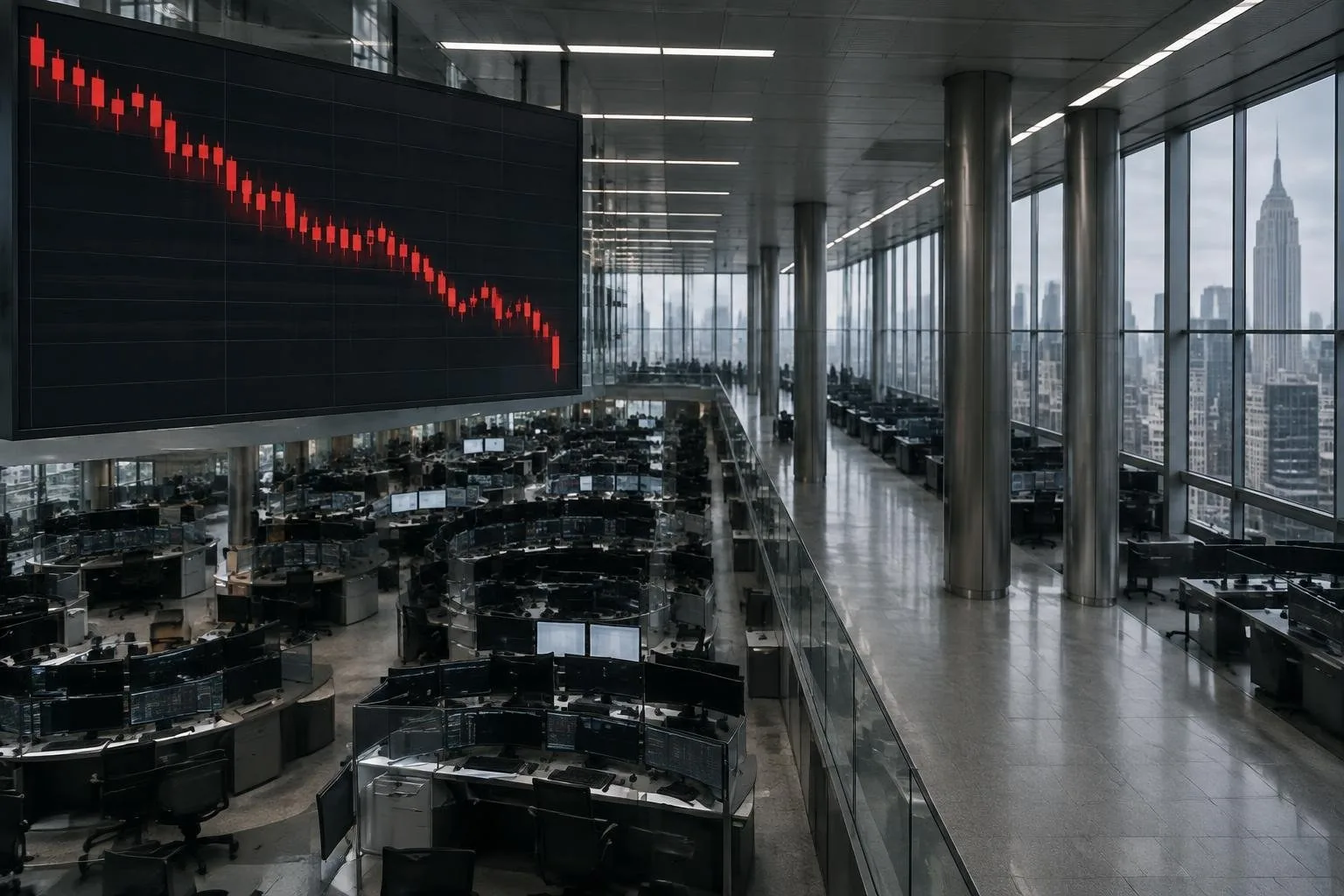
The weekend of November 5-6, 2026 marked a turning point for the United States equity market. A sweeping Democratic victory in Congress and several key state legislatures coincided with an abrupt tightening of capital for high-growth artificial intelligence projects. Investors, both institutional and retail, interpreted the political shift as a harbinger of stricter regulatory scrutiny and reduced financing for data-center expansion, prompting a rapid exit from the sector that had powered much of the year’s rally.
Within hours of the election results, the major benchmarks began to tumble. The Dow Jones Industrial Average slipped more than 1,800 points, a 3.4% decline, while the S&P 500 fell 4.3%. The technology-heavy Nasdaq Composite dropped 5.5%, pushing the index into correction territory. Even the Nasdaq-100, dominated by AI and chip leaders, lost 6.3%, erasing roughly $2.3 trillion in market value. The Philadelphia Semiconductor Index plunged 12%, with heavyweights such as Nvidia, Micron and AMD suffering double-digit percentage losses.
Indexes crumble as AI and chip names melt
Analysts point to the confluence of three forces behind the slide. First, the newly empowered Democratic congress is expected to pursue tighter oversight of data-center construction and AI model licensing, raising compliance costs for firms that rely on massive compute farms. Second, the political uncertainty that had buoyed risk-appetites evaporated, prompting investors to re-price the sector’s future cash flows. Third, the market’s technical momentum, which had accelerated throughout 2026, suddenly reversed, triggering stop-loss orders that magnified the fall.
Shares of Nvidia (NVDA) fell more than 15% in the two-day window, while Micron Technology (MU) saw a drop of over 20%. Semiconductor manufacturers are especially vulnerable because their capital-intensive projects depend on long-term financing, which appears to be drying up. The sell-off also rippled into related hardware and cloud providers, including SpaceX and Tesla, whose valuations were pressured by the prospect of heightened regulation on AI-driven services.
Retail and institutional capitulation reaches 2020 levels
Perhaps the most striking signal came from the retail side of the market. Data from Vanda Research indicated that everyday investors sold a net $338 million in individual U.S. stocks on Thursday, the heftiest single-day outflow since March 2020’s pandemic panic. Viraj Patel, a global macro strategist at Vanda, described the episode as a “total capitulation” by retail participants, noting the absence of the usual “buying the dip” behavior that characterises market corrections.
Institutional hedge funds were equally aggressive. Many fund managers, having amassed sizable gains on AI-themed equities throughout the year, rushed to lock in profits before the calendar year’s end, a maneuver Patel likened to “shooting the generals.” Systematic and leveraged strategies also contributed to the pressure, forcing a wave of forced selling that amplified price drops. While most retail investors exited individual shares, a modest flow continued into leveraged exchange-traded funds such as the ProShares UltraPro QQQ (TQQQ) and Direxion Daily Semiconductor Bull 3X Shares (SOXL), suggesting some participants were still chasing upside on a short-term basis.
Political backdrop and broader economic cues
The election outcome reshaped more than just equity valuations. Four states that flipped to Democratic control—Ohio, Pennsylvania, Michigan and Wisconsin—host roughly half of the nation’s upcoming data-center capacity. Their new leadership is expected to impose stricter zoning, environmental, and security requirements on large-scale compute facilities, effectively throttling the supply pipeline that AI firms have relied upon for rapid scaling.
Concurrently, oil markets reacted to geopolitical chatter. Brent crude hovered around $98 per barrel and U.S. WTI near $90, as investors weighed the potential for a United States-Iran diplomatic settlement following a statement from Vice President JD Vance linking the mid-term loss to the ongoing Middle East conflict. The uncertainty added another layer of volatility to an already jittery market.
Labor data offered a brief counterpoint: a report from Challenger, Gray & Christmas showed October layoff plans fell to their lowest level since 2023, indicating that companies were pivoting toward retention rather than downsizing. Yet the confluence of political change, financing chill, and a historic retail sell-off created a perfect storm that drove U.S. equities into a broad correction, leaving investors to reassess exposure to the AI narrative that had defined much of 2026.