
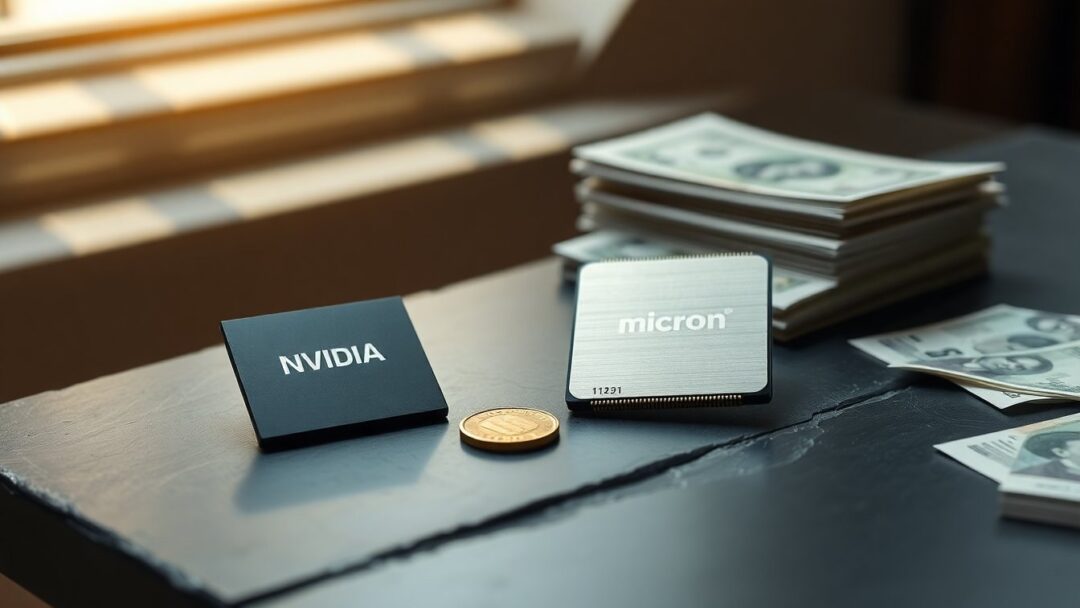
The semiconductor sector is witnessing a significant shift in institutional investment patterns. While Nvidia has long been a darling of big investors, recent data reveals a notable exodus of smart money from the company. This capital isn’t leaving the chip sector altogether, but rather rotating to other players within the same industry, particularly Micron.
This movement isn’t just a temporary blip; it represents a strategic realignment based on several key factors. Understanding these dynamics can provide valuable insights for investors navigating the complex landscape of AI and semiconductor technologies.
Institutional Investors Are Leaving Nvidia
Data from the 20-day Chaikin Money Flow indicator shows Nvidia with one of the most negative readings among major chip stocks, hovering around -0.19. This metric serves as a proxy for institutional money flow, suggesting that large investors are significantly reducing their positions in Nvidia. The situation is stark when compared to peers like Micron, which is still seeing accumulation.
The impact on Nvidia’s stock price has been noticeable. While the broader semiconductor index has nearly doubled over the past six months, Nvidia has seen minimal growth, with a year-to-date increase of only about 2.6% and an 18% decline from its May peak. The stock’s relative strength index stands at 52.9, indicating it’s lagging behind the sector.
Insider Activity Reflects Market Sentiment
Adding to the bearish signals, insider activity has been notable. In early June, Nvidia director Mark Stevens sold approximately 1 million shares worth roughly $221 million. This transaction, along with other insider sales that month, underscores the lack of confidence among those closest to the company.
The Case for Micron: Where the Money is Going
The capital exiting Nvidia appears to be flowing into the memory chip sector, with Micron emerging as a primary beneficiary. Micron recently reported record revenue of $41.46 billion, representing a staggering 346% increase year-over-year. The stock surged about 15% following the earnings release, and the company’s guidance for next-quarter sales near $50 billion has further fueled investor enthusiasm.
Micron’s success can be attributed to the high demand for its specialized AI memory, particularly its HBM (High Bandwidth Memory) which is currently sold out. As a key supplier to Nvidia, Micron is well-positioned to capitalize on the ongoing AI boom. The stock has roughly tripled in value this year, briefly surpassing Meta in market capitalization.
Nvidia’s Customers Become Competitors
Another critical factor driving the rotation away from Nvidia is the growing trend of its largest customers developing their own AI chips. Companies like Alphabet are now selling their in-house AI chips to external clients, and Anthropic plans to invest approximately $200 billion with Alphabet over the next five years. This shift reduces Nvidia’s customer base and intensifies competition in the AI chip market.
Analysts estimate that Alphabet’s chip business could expand from about $3 billion in 2026 to $25 billion in 2027. This growth trajectory raises concerns about Nvidia’s ability to maintain its premium pricing, particularly amid broader market caution regarding AI spending.
Analyst Sentiment: A Mixed Picture
Despite the negative money flow, Nvidia maintains a Strong Buy consensus among analysts, with 37 buy ratings, one hold, and no sells over the past month. The average price target stands near $309. However, there are signs of diminishing confidence in the stock’s premium valuation.
For instance, Wells Fargo analyst Aaron Rakers recently reduced his price target from $375 to $315 while retaining his buy rating. This adjustment reflects a broader trend where analysts remain bullish on Nvidia’s business fundamentals but are increasingly skeptical about its premium valuation.
Fundamentals vs. Market Flow
The tension between Nvidia’s strong fundamentals and the negative money flow is evident. The company’s revenue continues to grow rapidly, and demand for its Grace Blackwell systems remains robust. Additionally, the forward price-to-earnings ratio has slipped to roughly 20 times earnings, making it relatively cheap compared to several AI peers.
Wedbush Securities maintains a $330 price target for Nvidia, viewing the recent selloff as a tactical buying opportunity. However, until the Chaikin Money Flow indicator signals a return to accumulation, the stock is likely to face continued selling pressure.
The semiconductor sector is undergoing a significant realignment, with institutional investors shifting their focus from Nvidia to other players like Micron. This rotation is driven by several factors, including high demand for memory chips, the emergence of competitors, and changing market dynamics. While Nvidia’s fundamentals remain strong, the negative money flow suggests that the stock may continue to underperform in the near term. Investors should closely monitor these trends as they navigate the evolving landscape of the AI and semiconductor markets.


